The Best Open Source Alternative to Rewardful: Why Self-Hosting Wins

The Best Open Source Alternative to Rewardful: Why Self-Hosting Wins
Rewardful starts at $49/month. That’s before a single affiliate has driven a single dollar of revenue for your SaaS. As your Monthly Recurring Revenue (MRR) climbs, your plan requirement scales with it. The pricing is fundamentally structured to extract more cash from your margins precisely when your affiliate program is working. That is not a partnership—that is a toll booth on your own growth.
The developer community has already systematically broken this proprietary pattern in adjacent infrastructure categories. You don’t pay Mixpanel when you can self-host PostHog. You don’t pay a managed auth vendor when you can spin up Supabase. You don’t pay for a black-box analytics SaaS when Plausible runs on a minimal VPS for the price of a single compute instance. The exact same architectural logic applies to affiliate tracking.
Paying a compounding monthly subscription fee just to store your own conversion records behind a closed API is a legacy pattern. You should own your attribution data.
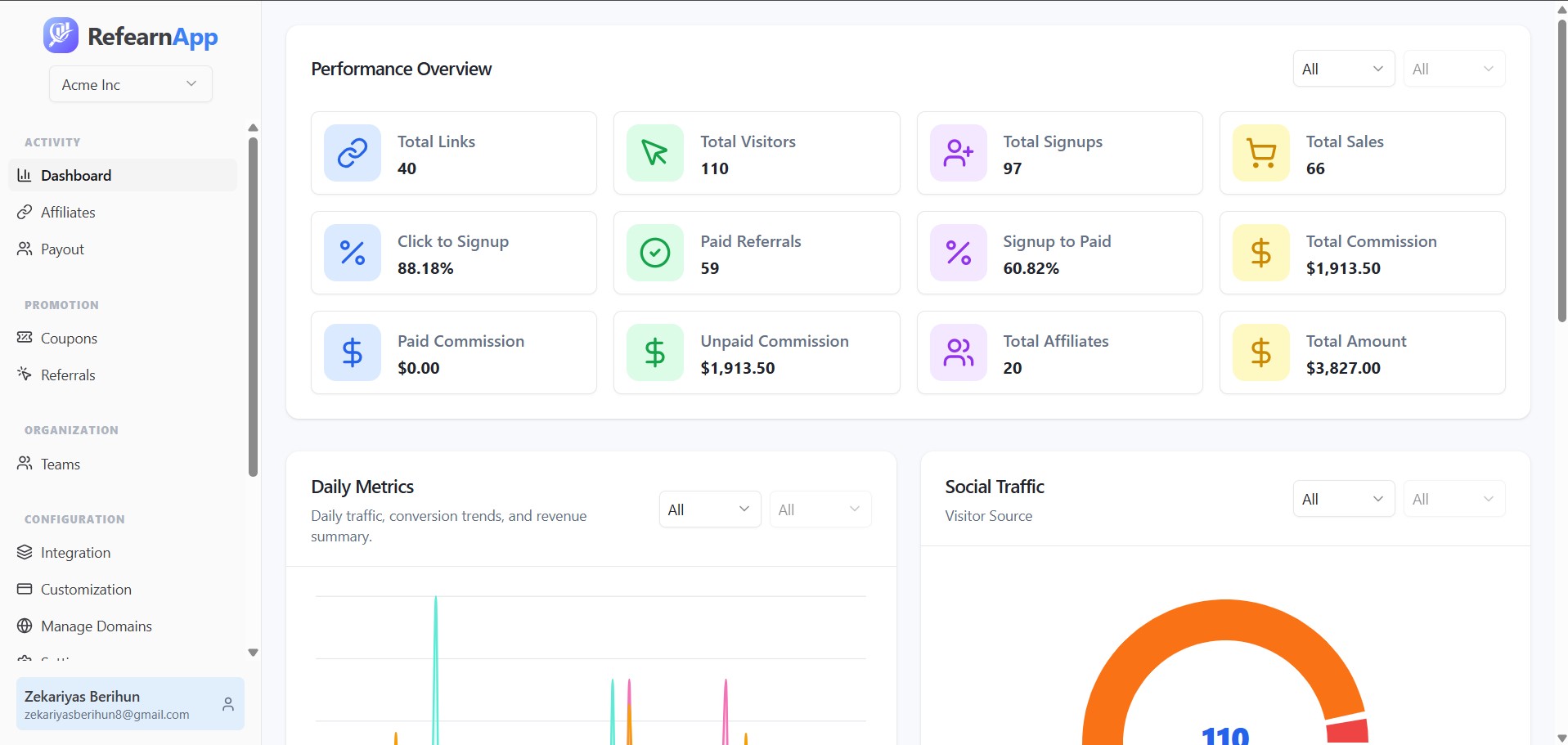
RefearnApp is the open-source, self-hostable affiliate management platform built to give developer-founders complete structural control without the monthly subscription tax. This guide covers the architectural advantages of self-hosting, the schema design, and how to deploy your instance in under 30 minutes.
Why the Architecture of Affiliate Tracking Belongs in Your Database
When you offload affiliate attribution to a closed-source platform, you introduce an operational blind spot. The core engineering arguments for pulling this data layer back into your own infrastructure are absolute:
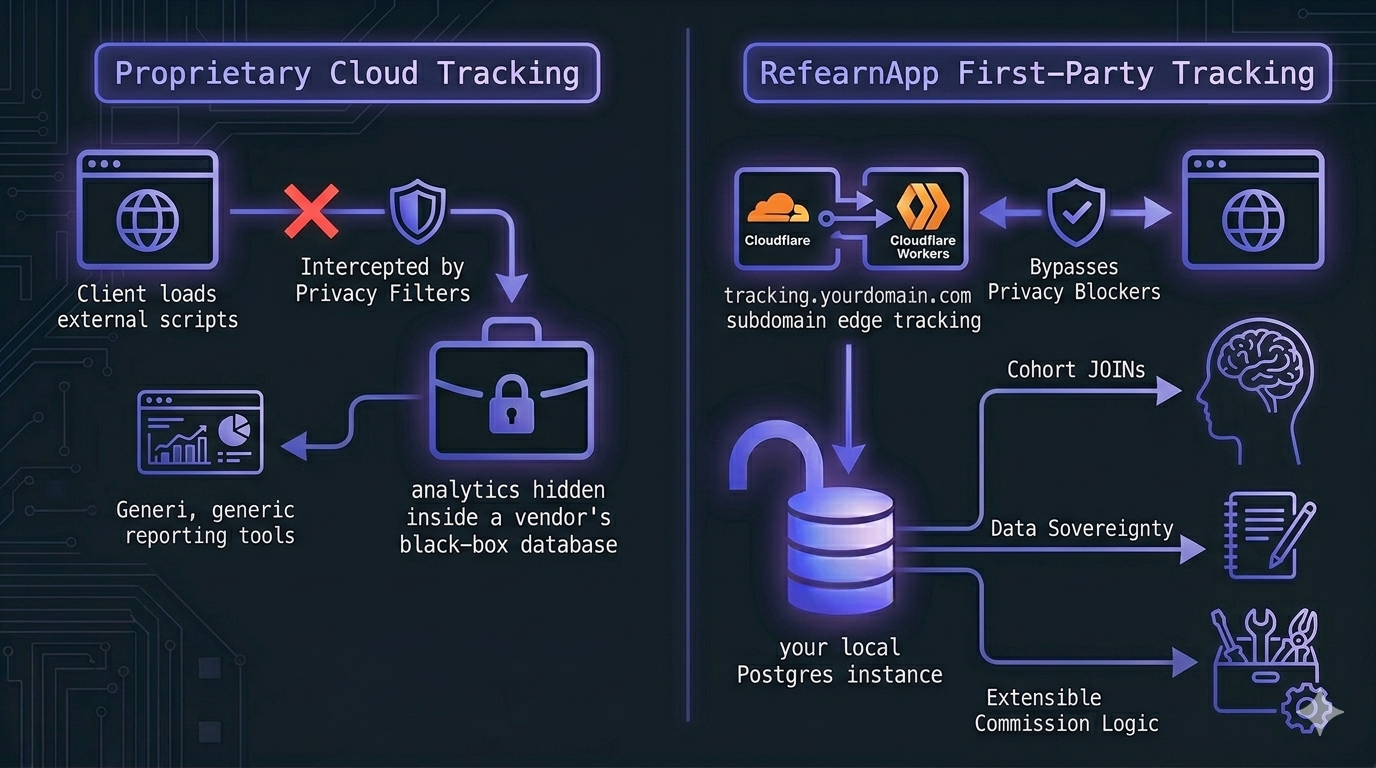
- 100% Data Sovereignty: Your conversion events, click logs, and commission histories live in your own database cluster. No API rate limits, no artificial data retention caps, and no export quotas.
- Zero Frontend Bloat: You stop injecting third-party JavaScript tracking scripts controlled by an external cloud provider into your client bundle. This eliminates an uncontrollable external dependency.
- Relational JOIN Performance: Because your affiliate tables live in your own Postgres database, cross-referencing affiliate conversions against internal user tables, specific plan upgrades, or churn metrics is a straightforward SQL query rather than a messy multi-platform API aggregation.
Feature Breakdown: Rewardful vs. RefearnApp
Choosing between a closed-source subscription and a self-hosted platform is an architectural decision. The table below outlines the core technical realities of both paradigms:
| Feature | Rewardful | RefearnApp |
|---|---|---|
| License | Proprietary, Closed-Source | Open-Source (MIT / AGPL-3.0) |
| Infrastructure | Cloud-only managed black box | Self-hosted via Docker / Coolify / VPS |
| Data Access | Locked behind REST API & UI | Full Postgres/SQL Access |
| Tracking Context | Third-Party Network Scripts | First-Party Subdomain Edge Workers |
| Ad-Blocker Vulnerability | High (Blocked by Brave, Safari ITP, uBlock) | Zero (Runs as your own API endpoint) |
| Stripe Integration | Built-in (External OAuth/Webhooks) | Built-in (Native Metadata & Webhooks) |
| Pricing Model | $49 to $299+/mo (Scales with revenue) | Free (Pay only for your own infrastructure) |
The Underlying Database Schema
To illustrate the transparency of open source, here is the clean SQL structure used to manage tracking links, clicks, and affiliate mappings natively inside your PostgreSQL instance:
-- Base affiliate identity
CREATE TABLE affiliates (
id           UUID PRIMARY KEY DEFAULT gen_random_uuid(),
slug         TEXT UNIQUE NOT NULL,
status       TEXT NOT NULL DEFAULT 'active',
created_at   TIMESTAMPTZ NOT NULL DEFAULT NOW()
);

  -- First-party tracking links generated for affiliates
  CREATE TABLE affiliate_links (
    id           UUID PRIMARY KEY DEFAULT gen_random_uuid(),
    affiliate_id UUID NOT NULL REFERENCES affiliates(id) ON DELETE CASCADE,
    target_url   TEXT NOT NULL,
    is_active    BOOLEAN NOT NULL DEFAULT true,
    created_at   TIMESTAMPTZ NOT NULL DEFAULT NOW()
  );

  -- Edge click analytics table
  CREATE TABLE affiliate_clicks (
    id           UUID PRIMARY KEY DEFAULT gen_random_uuid(),
    affiliate_id UUID NOT NULL REFERENCES affiliates(id) ON DELETE CASCADE,
    ip_address   TEXT,
    user_agent   TEXT,
    referrer     TEXT,
    clicked_at   TIMESTAMPTZ NOT NULL DEFAULT NOW()
  );

  CREATE INDEX idx_clicks_affiliate_id ON affiliate_clicks(affiliate_id);
  CREATE INDEX idx_clicks_timestamp ON affiliate_clicks(clicked_at);
Bypassing Third-Party Tracking Blockers at the Infrastructure Layer
This is the silent point of failure that closed-source affiliate tracking platforms cannot easily fix due to their multitenant SaaS architectures.
When you load a traditional tracking script from an external domain like rewardful.com or r.stripe.com, browser-side privacy guards evaluate it in a third-party context. This has massive implications in modern developer workflows:
- uBlock Origin & Ad-Blockers: Categorically drop requests to known external tracking endpoints based on community blocklists, causing conversion data loss.
- Brave Browser: Explicitly blocks cross-site trackers and drops third-party storage access entirely before the script can evaluate the click identifier.
- Safari Intelligent Tracking Prevention (ITP): Aggressively caps the lifetime of cookies dropped by third-party tracking domains to 7 days, rendering later conversions completely invisible.
If your SaaS sells to developers, technical founders, or privacy-conscious creators, this silent blocking profile routinely wipes out 30% to 40% of your valid affiliate attributions.
The Solution: First-Party Subdomain Tracking
By self-hosting your affiliate application, your tracking endpoint executes on your own infrastructure under a native subdomain (e.g., tracking.yourdomain.com). It routes tracking cookies and pixel beacons back to your own server context, making it indistinguishable from your application’s core feature APIs.
Core Tech Stack Alignment
Many open-source self-hosted applications create massive maintenance overhead because they are written using alien ecosystems or outdated design frameworks. RefearnApp completely bypasses this issue by aligning with the high-performance stacks modern developer-founders run.
The platform is explicitly designed with clean boundaries using type-safe engineering components:
- Frontend Framework: Next.js (App Router) and TypeScript—allowing for quick layout changes and uniform schema extensions without complex context switching.
- Server State Management: TanStack Query—delivering optimized caching, predictable data synchronization, and fast background panel revalidations out of the box.
- Database Layer: Drizzle ORM paired with PostgreSQL—enabling type-safe migrations and schema management matching your core software product code templates.
- High-Performance Tracking: Cloudflare Workers running at the network edge to manage low-latency click evaluations with zero cold-start bottlenecks.
For a deep dive into implementing server-side payment attribution directly over this architecture, read our complementary guide on how to track Stripe coupons for affiliates.
1-Click Deployment via Coolify
You do not need to spend hours managing raw infrastructure or writing complex system scripts to get your open-source tracking layer live. RefearnApp is optimized to run as a native, self-hosted service directly inside Coolify—giving you a Vercel-like Git-push or Docker-backed deployment pipeline on your own virtual private server (VPS).
To deploy, you simply add a new application inside your Coolify dashboard using our official image repository, map your tracking subdomain (e.g., tracking.yourdomain.com), and provide your core database configuration strings.
Required Environment Configuration
When launching your instance within Coolify, ensure your application resource variables are defined to establish the first-party secure connection context:
NEXT_PUBLIC_APP_URL=https://tracking.yourdomain.com
DATABASE_URL=postgresql://user:password@your-postgres-host:5432/refearn

# Stripe Webhook Synchronization Tokens
STRIPE_SECRET_KEY=sk_live_51...
STRIPE_WEBHOOK_SECRET=whsec_...
For a comprehensive, step-by-step walkthrough detailing server configuration, edge routing rules, and verification checklists, head straight over to our production guide.
Conclusion: Take Control of Your Affiliate Data
Why pay a closed-source service to hold your conversion metrics hostage when you can manage the entire engine natively on infrastructure you already own?
Self-hosting your affiliate tracking layer saves significant platform costs as your program scales, helps you bypass user ad-blockers, and provides direct relational visibility over your marketing databases.
Ready to Build Without Subscription Limits?
RefearnApp is fully open-source, self-hostable, and AGPL-3.0 licensed. You can deploy it completely free on your own infrastructure using Coolify or follow our step-by-step setup walkthrough.
Self-Hosted Open Source
Deploy directly on your own VPS via Coolify. Enjoy 100% data ownership.
Managed RefearnApp Cloud
Get up and running instantly. Skip the manual environment configuration, provisioning, and setup tasks with a fully turnkey, zero-config deployment.
Try Managed Cloud